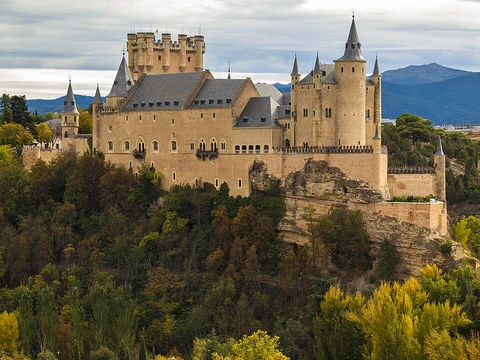
Warwick Castle
Medieval castle turned country house, now operated by Merlin Entertainments.

Warwick Castle is a medieval castle in Warwick, England, developed from a wooden fort built by William the Conqueror in 1068. The original motte-and-bailey castle overlooking the River Avon was rebuilt in stone during the 12th century. During the Hundred Years War, the facade opposite the town was refortified, resulting in one of the most recognisable examples of 14th-century military architecture. It was used as a stronghold until the early 17th century, when it was granted to Sir Fulke Greville by James I in 1604. Greville converted it to a country house, and it was owned by the Greville family (who became Earls of Warwick in 1759) until 1978, when it was bought by the Tussauds Group. In 2007, the Tussauds Group was purchased by the Blackstone Group, which merged it with Merlin Entertainments. Warwick Castle was then sold to Nick Leslau's investment firm, Prestbury Group, under a sale and leaseback agreement. Merlin continues to operate the site under a renewable 35-year lease.
- Location
- Warwick, on a sandstone bluff at a bend of the River Avon
- Original built
- 1068 by William the Conqueror
- Rebuilt in stone
- 12th century
- Converted to country house
- 1604 by Sir Fulke Greville
- Owned by Greville family until
- 1978
- Current operator
- Merlin Entertainments under a renewable 35-year lease
Lore & Background
Warwick Castle originated as a motte-and-bailey fortification built by William the Conqueror in 1068 to control the Midlands as he advanced northwards. Four houses belonging to the Abbot of Coventry were demolished to provide space. The original wooden structure was replaced with a stone keep during the 12th century under King Henry II. During the Hundred Years War, the facade opposite the town was refortified, adding Caesar's Tower and Guy's Tower, which are considered key examples of 14th-century military architecture. Caesar's Tower features a unique double parapet and contained a grim basement dungeon; according to local legend dating back to at least 1644 it is also known as Poitiers Tower, either because prisoners from the Battle of Poitiers in 1356 may have been imprisoned there, or because the ransoms raised from the battle helped to pay for its construction. The gatehouse features murder holes, two drawbridges, a gate, and portcullises. The facade overlooking the river was designed as a symbol of the power and wealth of the Beauchamp earls and would have been 'of minimal defensive value'. In 1604, King James I granted the castle to Sir Fulke Greville, who converted it to a country house. The Greville family, who became Earls of Warwick in 1759, owned it until 1978, when it was sold to the Tussauds Group. In 2007, the Tussauds Group was purchased by the Blackstone Group and merged with Merlin Entertainments; the castle was then sold to Nick Leslau's Prestbury Group under a sale and leaseback agreement, with Merlin continuing to operate the site under a renewable 35-year lease. The castle's position on a sandstone bluff at a bend of the River Avon provided natural defenses, with the river eroding the rock to form a cliff. During the 12th century, King Henry I granted lands including Kenilworth to Geoffrey de Clinton to counter the influence of Roger de Beaumont, 2nd Earl of Warwick. An Anglo-Saxon burh was established on the site in 914, with fortifications instigated by Æthelflæd, daughter of Alfred the Great. The burh she established was one of ten which defended Mercia against the invading Danes.
Reader's Guide
Warwick Castle's significance lies in its continuous evolution from a Norman motte-and-bailey fortification to a 14th-century military stronghold, then to a country house, and finally to a modern tourist attraction. Its refortification during the Hundred Years War produced some of the most recognisable examples of 14th-century military architecture, including Caesar's Tower and Guy's Tower. The castle's role in English history includes involvement in the Barons' Rebellion of 1173–74, the Second Barons' War of 1264–67, and the Wars of the Roses, where it was used to imprison King Edward IV in the summer of 1469. The castle was also the site of the capture of Piers Gaveston, 1st Earl of Cornwall, by Guy de Beauchamp, 10th Earl of Warwick, in 1312; Gaveston was imprisoned in Warwick Castle until his execution on 19 June 1312. In the early 1480s, King Richard III instigated the construction of two gun towers, Bear and Clarence Towers, which were left unfinished on his death in 1485; with their own well and ovens, the towers were an independent stronghold from the rest of the castle, possibly in case of mutiny by the garrison. Today, operated by Merlin Entertainments under a renewable 35-year lease, it remains a major heritage site, illustrating the transition from medieval fortress to modern leisure destination. Its location on the River Avon and proximity to transport links make it accessible, while its history as a site of an Anglo-Saxon burh adds depth to its legacy.
Did You Know?
- An Anglo-Saxon burh was established on the site in 914, with fortifications instigated by Æthelflæd, daughter of Alfred the Great.
- In 1153, Gundreda de Warenne surrendered control of the castle to Henry of Anjou after being tricked into believing her husband Roger de Beaumont was dead; according to the Gesta Regis Stephani, Roger died upon hearing the news.
- Caesar's Tower features a unique double parapet and is also known as Poitiers Tower, either because prisoners from the Battle of Poitiers in 1356 may have been imprisoned there, or because the ransoms raised from the battle helped to pay for its construction.
- In the early 1480s, King Richard III instigated the construction of two gun towers, Bear and Clarence Towers, which were left unfinished on his death in 1485.
- Warwick Castle is about 1.6 kilometres (1 mi) from Warwick railway station and less than 3.2 kilometres (2.0 mi) from junction 15 of the M40 motorway.
Common Misconceptions (Editorial)
Some people assume Warwick Castle was originally built in stone, but the facts confirm it started as a wooden motte-and-bailey fort in 1068 and was only rebuilt in stone during the 12th century. Another common misconception is that the castle was continuously used as a military stronghold throughout its history; in fact, it was converted into a country house starting in 1604 and was later operated as a tourist attraction. Additionally, while the river-facing facade may appear purely defensive, the record notes it was designed as a symbol of power and wealth and was "of minimal defensive value."
Why It Matters (Editorial)
Warwick Castle endures because it bridges nearly a thousand years of English history, from its origins as a Norman fortification to its transformation into a country house and modern tourist destination. Its layered architecture and evolving purpose—defensive fortress, noble residence, and now a major heritage attraction—illustrate how historical sites can adapt while preserving the stories that give them lasting cultural significance.
Frequently Asked Questions
What is Warwick Castle?
Warwick Castle is a medieval fortress perched on a sandstone bluff above a bend in the River Avon in Warwick, England. It began as a wooden fort in 1068 and evolved into one of the country's most recognizable castle sites, now operating as a major tourist attraction.
Who originally built Warwick Castle and when?
William the Conqueror commissioned the original wooden fortification in 1068, just a few years after the Norman Conquest. The structure was later rebuilt in stone during the 12th century and heavily refortified during the Hundred Years War.
How did Warwick Castle stop being a military stronghold?
In 1604, Sir Fulke Greville converted the castle from a defensive fortress into a grand country residence. It then remained in the Greville family's possession for nearly four centuries, until 1978.
Who runs Warwick Castle today?
The site is currently operated by Merlin Entertainments under a renewable 35-year lease. It functions as a large-scale visitor attraction featuring medieval-themed experiences rather than serving any military or residential purpose.
Why is Warwick Castle considered architecturally important?
Its refortification during the Hundred Years War produced a well-preserved example of 14th-century military design, making it a key reference point for studying medieval defensive architecture in England.
More in Castles 1-22
Spotted an error? Know more?
This is a living reference — every entry is fact-audited, and reader corrections feed straight into our audit queue. Suggest an edit · See this site's audit record