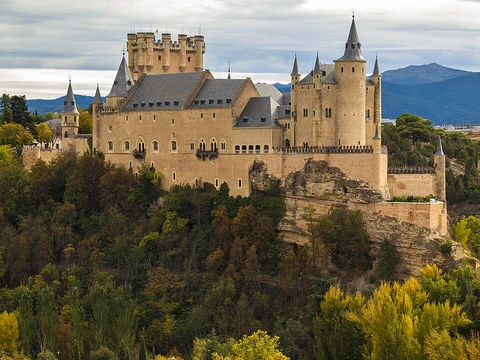
Bran Castle
A Transylvanian fortress linked to Dracula myth but not Stoker's novel.

via Wikipedia: Bran Castle · see source
Bran Castle is a castle in Bran, 25 kilometers southwest of Brașov, built by Saxons in 1377 under a privilege from Louis I of Hungary. It is a national monument and landmark in Transylvania, situated on the Transylvanian side of the historical border with Wallachia. Marketed outside Romania as Dracula's Castle, it is presented as the home of the title character in Bram Stoker's novel Dracula, though there is no evidence Stoker knew of this castle and its description does not match the novel. The castle is now a museum dedicated to displaying art and furniture collected by Queen Marie.
- location
- Bran, 25 km southwest of Brașov, Transylvania
- built
- 1377 (stone castle by Saxons)
- original builder
- Saxons of Kronstadt (Brașov) under Louis I of Hungary
- current use
- Museum displaying art and furniture collected by Queen Marie
- notable resident
- Queen Marie of Romania (favorite home and retreat)
- ownership
- Returned in 2006 to Archduke Dominic of Austria and his sisters
Verified Timeline
Lore & Background
The castle's site may have held an earlier fortification built by Székelys in the 11th century, according to the questionable Székely Chronicle of Csik, but this is uncertain. The stone castle was first documented in 1377 when Louis I of Hungary granted Saxons permission to build it. It served in defense against the Ottoman Empire in 1438–1442 and later as a customs post. Contrary to some claims, there is no reliable historical evidence that Vlad the Impaler was imprisoned at Bran Castle in 1462; most historians agree he was held in Hungary. The castle became a royal residence after the 1920 Treaty of Trianon, given to the royal house by the Saxons of Kronstadt-Braşov. Queen Marie made it her favorite home and retreat, commissioning extensive renovation by Czech architect Karel Zdeněk Líman. Seized by the communist regime in 1948, it was returned in 2006 to Archduke Dominic of Austria and his sisters. Today it operates as a private museum.
Reader's Guide
Bran Castle's significance lies in its layered history as a Saxon-built fortress, a customs post, and a royal residence for Queen Marie, who renovated it extensively. After the Treaty of Trianon, it became part of Romania and was given to the royal house. Seized by the communist regime in 1948, it was returned in 2006 to Archduke Dominic and his sisters. Today it operates as a private museum. Its popular association with Dracula is tourism-driven, as historians agree Vlad the Impaler never lived there and Stoker never visited or described it. The castle also hosts an open-air museum of traditional Romanian peasant structures.
Did You Know?
- The Teutonic Order built a wooden castle called Dietrichstein on the site in 1212, named after Commander Theodericus.
- Queen Marie of Romania commissioned extensive renovations of Bran Castle by Czech architect Karel Zdeněk Líman.
- Princess Ileana, daughter of Queen Marie, ran a hospital at Bran Castle during World War II.
- The castle was returned to Archduke Dominic of Austria and his sisters in 2006 after a 2005 restitution law.
- Bran Castle became Romania's first private museum when it reopened to the public on 1 June 2009.
Layered Origins: From Wooden Stockade to Saxon Stone
Before the stone walls that stand today, the Bran site carried a far older defensive memory. A questionable 11th-century source, the Székely Chronicle of Csik, suggests Székely settlers under King Ladislaus I of Hungary raised an early fortification to guard against Cuman and Pecheneg raids. That structure likely perished in a subsequent attack, and the territory was later handed to the Teutonic Order. In 1212, the Order erected a wooden stronghold called Dietrichstein—named for a regional commander, Theodericus, per a surviving document—at the mouth of a mountain pass traders had crossed for over a millennium. Royal troops destroyed this wooden castle around 1225 during the Order's expulsion from Hungary. The definitive stone fortress arrived in 1377, when Louis I of Hungary granted the Saxons of Kronstadt the privilege to build it at their own cost and labour. Unlike many noble castles of the era, Bran was conceived almost purely as a military bulwark protecting German colonists. It saw action against Ottoman forces in the 1430s and 1440s, served as a customs checkpoint between Transylvania and Wallachia, and in 1530 repelled a Wallachian army under Moise. Its strategic military importance endured until the mid-18th century.
The Dracula Myth: Marketing Versus History
Perhaps no structure in Romania has been more aggressively rebranded by popular culture than Bran Castle. Marketed to international visitors as Dracula's Castle, it is presented as the residence of the vampire protagonist in Bram Stoker's 1897 novel. Yet the historical record offers no support for this identification. There is no evidence that Stoker ever learned of this particular fortress, and his literary description of a crumbling, decaying castle bears no resemblance to Bran's relatively intact stone structure. The only thread connecting the site to the Dracula legend is the byname Drăculea of Vlad the Impaler, voivode of Wallachia from 1448 to 1476, which phonetically echoes the novel's title. Vlad is known to have passed through the Bran Gorge on several occasions, but he played no significant role in the fortress's history. The castle was never his residence; it was a Saxon-built military installation and customs post. The association is, in the end, a marketing construct that has overshadowed the building's genuine medieval and royal heritage.
Royal Retreat and the Long Fight for Ownership
The 1920 Treaty of Trianon redrew Europe's map and transferred Transylvania to the Kingdom of Romania. The Saxons of Kronstadt-Brașov, who had held the castle for centuries, no longer had a use for it and little interest in financing its upkeep, so they handed it to the Romanian royal house. Queen Marie made Bran her favourite retreat and commissioned an extensive renovation under Czech architect Karel Zdeněk Líman. After her, the property passed to her daughter Princess Ileana, who operated a hospital within its walls during World War II. In 1948 the communist regime expelled the royal family and seized the castle. Decades of state ownership followed until 2005, when a restitution law opened the door for claims on illegally expropriated property. In 2006, after legal proceedings, ownership was awarded to Archduke Dominic of Austria, Ileana's son. A parliamentary investigation committee declared the transfer illegal, but the Constitutional Court rejected that petition, and a government commission reaffirmed the restitution's validity. In 2009, full administration was finally handed to Dominic and his sisters, Archduchesses Maria Magdalena and Elisabeth.
A Living Museum in the Bran Valley
Today Bran Castle stands as a national monument and landmark in Transylvania, perched on the Transylvanian side of the old border with Wallachia, twenty-five kilometres southwest of Brașov along road DN73. Its interior is dedicated to showcasing the art and furniture collections assembled by Queen Marie over her lifetime. Visitors may explore the rooms independently or join a guided tour that contextualises the royal history within the walls. At the foot of the hill, a small open-air museum displays traditional peasant structures from the Bran region—cottages, barns, and water-driven machinery—offering a glimpse into the rural life that surrounded the fortress for centuries. In June 2009, the Habsburg family opened the refurbished castle to the public as Romania's first private museum, presenting a joint strategic concept with the village of Bran to preserve the site's prominent cultural role. The castle thus functions simultaneously as a royal heritage site, a tourist destination, and a community anchor.
Common Misconceptions (Editorial)
Many people believe Bran Castle was the inspiration for Bram Stoker's Dracula and that it was the home of Vlad the Impaler. However, the facts on record state there is no evidence Stoker knew of this castle, and most historians agree Vlad was held in Hungary, not imprisoned at Bran Castle in 1462.
Why It Matters (Editorial)
Bran Castle endures as a cultural landmark because it layers medieval military history with modern royal romance, offering a rare glimpse into the tastes of Queen Marie. Its contentious 20th-century journey—from royal retreat to communist seizure to private museum—also makes it a tangible symbol of Romania's political transformations.
Frequently Asked Questions
What is Bran Castle?
Bran Castle is a medieval stone fortress perched in the town of Bran, about 25 kilometers southwest of Brașov in Transylvania, Romania. It was erected in 1377 by Saxon settlers from Kronstadt under a royal privilege issued by King Louis I of Hungary.
Is Bran Castle really Dracula's Castle?
Although the site is heavily promoted abroad as the home of Bram Stoker's fictional vampire, no evidence shows that Stoker ever knew of or visited this particular fortress. The castle's physical layout also fails to match the setting described in the novel.
What role does Bran Castle play in history?
The fortress sits on the Transylvanian side of the old border with Wallachia, giving it a strategic position along a historical divide between the two regions. It is currently a designated national monument and public museum in Romania.
Who lived in Bran Castle?
Queen Marie of Romania regarded the castle as her favorite personal retreat and filled its rooms with art, furniture, and decorative pieces she gathered over the years. Much of that collection remains on display in the interior today as part of the museum.
Who owns Bran Castle now?
After long periods of state control, the property was handed back in 2006 to Archduke Dominic of Austria and his sisters, who are descendants of the Habsburg royal line.
More in Castles 1-22
Spotted an error? Know more?
This is a living reference — every entry is fact-audited, and reader corrections feed straight into our audit queue. Suggest an edit · See this site's audit record