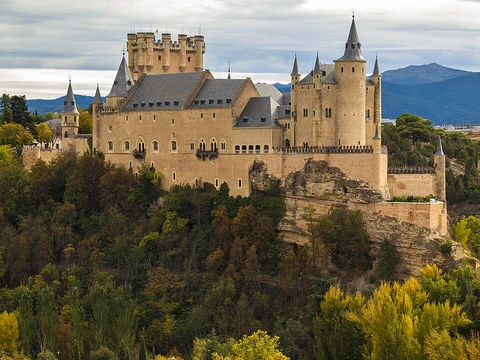
The Alcazar of Segovia
Medieval castle and former royal residence in Segovia, Spain.

The Alcázar of Segovia is a medieval castle located in the city of Segovia, in Castile and León, Spain. It has existed since at least the 12th century and is one of the most renowned medieval castles globally and one of the most visited landmarks in Spain. The fortress stands on a rocky crag at the western end of Segovia's Old City, above the confluence of the rivers Eresma and Clamores.
- Location
- Segovia, Castile and León, Spain
- Founded
- At least the 12th century
- Original builders
- Berber Almoravid dynasty
- Current use
- Museum and military archive
- Notable function
- Royal palace and fortress for Castilian monarchs
Lore & Background
The Alcázar of Segovia, like many fortifications in Spain, started off as a Roman castrum, but apart from the foundations, little of the original structure remains. The alcázar was built by the Berber Almoravid dynasty. Alfonso VIII and his wife, Eleanor of England, made this alcázar their principal residence and much work was carried out to erect the beginnings of the stone fortification seen today. The Alcázar of Segovia was one of the favourite royal residences starting in the 13th century. On 12 December news of King Henry IV's death reached Segovia and Isabella immediately took refuge within the walls of the Alcázar where she received the support of Andres Cabrera and Segovia's council. She was enthroned the next day as Queen of Castile and León. The next major renovation was conducted by King Philip II after his marriage to Anna of Austria. He added the sharp slate spires to reflect the castles of central Europe.
Reader's Guide
The Alcázar of Segovia served both as a royal palace and a fortress for the Castilian monarchs. Its history begins in the 12th or early 13th century when the royal family of Castile had quarters in the Alcázar. In the Homage tower, the treasure of the Crown of Castile was stored, from which funds were secured to finance Christopher Columbus's first voyage. The Alcázar housed the royal armory, which served as the basis for the one now exhibited in the Royal Armoury of Madrid. It has also been used as a state prison, a Royal Artillery College, and a military academy.
Did You Know?
- The treasure stored in the Homage tower helped finance Christopher Columbus's first voyage.
From Roman Stones to Almoravid Walls
The Alcazar of Segovia traces its deepest roots to a Roman military camp, though virtually nothing of that original structure survives beyond the foundations. The next major chapter belongs to the Berber Almoravid dynasty, whose builders raised the early fortress on the rocky crag overlooking the confluence of the Eresma and Clamores rivers. Almoravid architecture is a near-vanishing act in the Iberian Peninsula; the dynasty's short reign meant that much of what they constructed was later demolished or repurposed by successors, leaving scholars with remarkably little physical evidence. That changed when Alfonso VIII and his wife Eleanor of England, sister of Richard the Lionheart, chose the alcázar as their principal residence and commissioned the stone fortification that would eventually define the structure we recognize today.
Crown, Treasury, and the Making of a Queen
For centuries the Alcazar functioned simultaneously as a fortified stronghold and a royal palace for the monarchs of Castile. By the twelfth or early thirteenth century the Castilian royal family maintained dedicated quarters within its walls, a residence referred to in records as the "major palace." The Homage tower served as the vault for the Crown of Castile's treasure, and it was from those very reserves that the funds for Christopher Columbus's first transatlantic voyage were drawn. The Alcazar also housed the royal armory, the progenitor of the collection now displayed in Madrid's Royal Armoury.
Fires, Spires, and Centuries of Reinvention
The Alcazar's physical form has been shaped as much by destruction as by deliberate design. The Hall of Kings was erected in the aftermath to seat Parliament. King John II of Castile contributed what is arguably the single most significant addition, raising the "New Tower" still known today as the John II tower. A later transformation came under Philip II, who, after his marriage to Anna of Austria, commissioned the sharp slate spires that give the silhouette its distinctive central-European flavor. The exterior today presents a Herrerian-style courtyard, a moat, a drawbridge, and a keep, while the interior holds a chapel and a suite of noble rooms—the cuartos del Trono, de la Galera, de las Piñas, and de los Reyes—open to visitors.
From Artillery Academy to Living Heritage
The Alcazar's role as a military institution runs deep. The building had also served at various points as a state prison and a Royal Artillery College.
Common Misconceptions (Editorial)
- Some may think the Alcázar of Segovia was originally built as a royal palace, but it started as a Roman castrum and was later built by the Berber Almoravid dynasty, with little of the original Roman structure remaining. - It is commonly assumed that Christopher Columbus’s first voyage was funded solely by the Spanish crown, but the treasure stored in the Homage tower at the Alcázar helped finance the expedition.
Why It Matters (Editorial)
The Alcázar of Segovia endures as a symbol of Spanish royal power and resilience, from its origins as a Roman fort to its role as the stage for Queen Isabella’s enthronement. Its sharp slate spires and towering presence above the river confluence continue to captivate visitors, reminding us how medieval fortresses shaped the political and exploratory ambitions of an era.
Frequently Asked Questions
What is the Alcazar of Segovia?
It is a medieval fortress and former royal palace situated in the city of Segovia, in the Castile and León region of Spain. The structure has stood since at least the 12th century and served as both a defensive stronghold and a residence for Castilian kings.
Where exactly is the Alcazar of Segovia located?
The castle perches on a rocky crag at the western edge of Segovia's Old City, positioned above the point where the Eresma and Clamores rivers converge.
Who originally built the Alcazar of Segovia?
The Berber Almoravid dynasty is credited with constructing the original fortress on the site. The structure has been continuously occupied, modified, and rebuilt since at least the 12th century.
What is the Alcazar of Segovia used for today?
It currently functions as a public museum and also houses a military archive. Visitors can walk through its halls and learn about its long history as a seat of Castilian royal power.
More in Castles 1-22
Spotted an error? Know more?
This is a living reference — every entry is fact-audited, and reader corrections feed straight into our audit queue. Suggest an edit · See this site's audit record