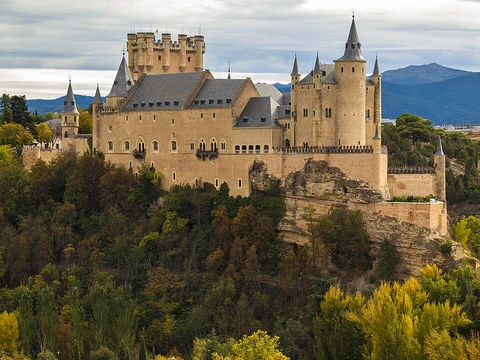
Windsor Castle
A royal residence embodying almost a millennium of architectural history.

Windsor Castle is a royal residence at Windsor in the English county of Berkshire, about 25 miles (40 km) west of central London. It is strongly associated with the English and succeeding British royal family, and embodies almost a millennium of architectural history.
- location
- Windsor in the English county of Berkshire, about 25 miles (40 km) west of centr
- built
- 11th century, after the Norman invasion of England by William the Conqueror
- area
- 13 acres (5.3 hectares)
- type
- Royal residence, fortification, palace
- known_for
- Longest-occupied palace in Europe; home of the royal House of Windsor
Verified Timeline
Lore & Background
The original castle was built in the 11th century, after the Norman invasion of England by William the Conqueror. Since the time of Henry I (who reigned 1100–1135), it has been used by the monarch and is the longest-occupied palace in Europe. Originally designed to project Norman dominance around the outskirts of London and oversee a strategically important part of the River Thames, Windsor Castle was built as a motte-and-bailey, with three wards surrounding a central mound. Gradually replaced with stone fortifications, the castle withstood a prolonged siege during the First Barons' War at the start of the 13th century. Henry III commissioned a luxurious royal palace within the castle during the middle of the century, and Edward III went further, rebuilding the palace to make an even grander set of buildings in what would become 'the most expensive secular building project of the entire Middle Ages in England'. Edward's core design lasted through the Tudor period, during which Henry VIII and Elizabeth I made increasing use of the castle as a royal court and centre for diplomatic entertainment.
Reader's Guide
Windsor Castle survived the tumultuous period of the English Civil War, when it was used as a military headquarters by Parliamentary forces and a prison for Charles I. At the Restoration of the monarchy in 1660, Charles II had much of Windsor Castle rebuilt with the help of the architect Hugh May, creating a set of extravagant Baroque interiors. After a period of neglect during the 18th century, George III and George IV had Charles II's palace renovated and rebuilt at colossal expense, producing the current design of the state apartments, full of Rococo, Gothic and Baroque furnishings. Queen Victoria made a few minor changes to the castle, which became the centre for royal entertainment for much of her reign. During the First World War, the historic estate inspired the naming of the royal House of Windsor. In the reign of George VI, it was used as a refuge by the royal family during the Luftwaffe bombing campaigns of the Second World War. An extensive restoration of several state rooms took place after the castle survived a fire in 1992. It is a popular tourist attraction, a venue for hosting state visits, and was the main residence of Elizabeth II from 2011 to 2022.
Did You Know?
- The motte at the heart of Windsor Castle is 50 feet (15 m) high and made from chalk originally excavated from the surrounding ditch.
- The Round Tower was extended upwards by 30 feet (9.1 m) in the early 19th century under architect Jeffry Wyatville.
- A bronze statue of Charles II on horseback, cast by Josias Ibach in 1679, sits beneath the Round Tower on a marble plinth carved by Grinling Gibbons.
- During the Second World War, the castle was used as a refuge by the royal family during the Luftwaffe bombing campaigns.
- The East Terrace rose garden, first laid out by George IV in the 1820s, was updated by Prince Philip, Duke of Edinburgh, after being used for victory garden production during World War II.
Origins & Military Purpose
Windsor Castle was built in the 11th century after the Norman invasion of England by William the Conqueror. It was originally designed to project Norman dominance around the outskirts of London and oversee a strategically important part of the River Thames. The castle was built as a motte-and-bailey, with three wards surrounding a central mound. Gradually replaced with stone fortifications, the castle withstood a prolonged siege during the First Barons' War at the start of the 13th century. Henry III commissioned a luxurious royal palace within the castle during the middle of the century, and Edward III went further, rebuilding the palace to make an even grander set of buildings in what would become 'the most expensive secular building project of the entire Middle Ages in England'. Edward's core design lasted through the Tudor period, during which Henry VIII and Elizabeth I made increasing use of the castle as a royal court and centre for diplomatic entertainment.
Architectural Layering & the Fictive Quality
The present-day castle was created during a sequence of phased building projects, culminating in the reconstruction work after a fire in 1992. It is in essence a Georgian and Victorian design based on a medieval structure, with Gothic features reinvented in a modern style. Since the 14th century, architecture at the castle has attempted to produce a contemporary reinterpretation of older fashions and traditions, repeatedly imitating outmoded or even antiquated styles. Architect Sir William Whitfield has pointed to Windsor Castle's architecture as having 'a certain fictive quality', the Picturesque and Gothic design generating 'a sense that a theatrical performance is being put on here', despite late 20th century efforts to expose more of the older structures to increase the sense of authenticity. The motte is 50 feet (15 m) high and made from chalk originally excavated from the surrounding ditch. The keep, called the Round Tower, on the top of the motte is based on an original 12th-century building, extended upwards by 30 feet (9.1 m) in the early 19th century under architect Jeffry Wyatville, to produce a more imposing height and silhouette. The current height of the tower has been criticised as being disproportionate to its width; archaeologist Tim Tatton-Brown, for example, has described it as a mutilation of the earlier medieval structure.
Royal Life & Political Turmoil
Windsor Castle survived the tumultuous period of the English Civil War, when it was used as a military headquarters by Parliamentary forces and a prison for Charles I. At the Restoration of the monarchy in 1660, Charles II had much of Windsor Castle rebuilt with the help of the architect Hugh May, creating a set of extravagant Baroque interiors. After a period of neglect during the 18th century, George III and George IV had Charles II's palace renovated and rebuilt at colossal expense, producing the current design of the state apartments, full of Rococo, Gothic and Baroque furnishings. Queen Victoria made a few minor changes to the castle, which became the centre for royal entertainment for much of her reign. During the First World War, the historic estate inspired the naming of the royal House of Windsor. In the reign of George VI, it was used as a refuge by the royal family during the Luftwaffe bombing campaigns of the Second World War. It was the main residence of Elizabeth II from 2011 to 2022.
The State Apartments & St George's Chapel
The castle's lavish early 19th-century state apartments were described by the art historian Hugh Roberts as 'a superb and unrivalled sequence of rooms widely regarded as the finest and most complete expression of later Georgian taste'. Inside the castle walls is the 15th-century St George's Chapel, considered by the historian John Martin Robinson to be 'one of the supreme achievements of English Perpendicular Gothic' design. The interior of the State Apartments was mostly designed by Wyatville in the early 19th century. Wyatville intended each room to illustrate a particular architectural style and to display the matching furnishings and fine arts of the period. Different rooms follow the Classical, Gothic and Rococo styles, together with an element of Jacobethan in places. Many of the rooms on the eastern end of the castle had to be restored following the 1992 fire, using 'equivalent restoration' methods – the rooms were restored so as to appear similar to their original appearance, but using modern materials and concealing modern structural improvements.
Common Misconceptions (Editorial)
Some believe Windsor Castle was built as a royal palace from the start, but it was originally designed as a motte-and-bailey fortification to project Norman dominance and oversee the River Thames. Another common misunderstanding is that it has been continuously inhabited by royalty since William the Conqueror; in fact, it was first used as a residence by a monarch starting with Henry I (reigned 1100–1135), not from its 11th-century construction.
Why It Matters (Editorial)
Windsor Castle endures not just as a royal residence but as a living chronicle of nearly a thousand years of English and British history, from Norman conquest to modern wartime refuge. Its continuous occupation and adaptation—spanning medieval sieges, Tudor courts, and 20th-century survival—make it a rare tangible link between past and present, embodying the resilience and evolution of the monarchy itself.
Frequently Asked Questions
What is Windsor Castle?
Windsor Castle is a royal residence and former fortification located in Windsor, Berkshire, roughly 25 miles west of central London. It has served as a primary home for the British royal family since the 11th century, following the Norman conquest.
How long has Windsor Castle been continuously occupied?
Windsor Castle is recognized as the longest-occupied palace in Europe, with nearly a thousand years of unbroken royal use stretching back to the 11th century. Its 13-acre grounds have been reshaped and rebuilt by successive monarchs over that entire span.
What is Windsor Castle's role or function today?
The castle operates as a working royal residence, a ceremonial venue, and a historic fortification all at once. It is the official home of the House of Windsor, hosting state events, private family life, and public tours.
Where exactly is Windsor Castle located?
It sits in the town of Windsor, in the county of Berkshire, England, about 25 miles west of central London. The site covers roughly 13 acres (5.3 hectares) of grounds.
Why is Windsor Castle significant in castle history?
Windsor Castle matters because it layers almost a millennium of architectural evolution, with additions made by nearly every monarch since the Norman invasion. It stands as the longest-occupied palace in Europe and the enduring seat of the British royal family.
More in Castles 1-22
Spotted an error? Know more?
This is a living reference — every entry is fact-audited, and reader corrections feed straight into our audit queue. Suggest an edit · See this site's audit record