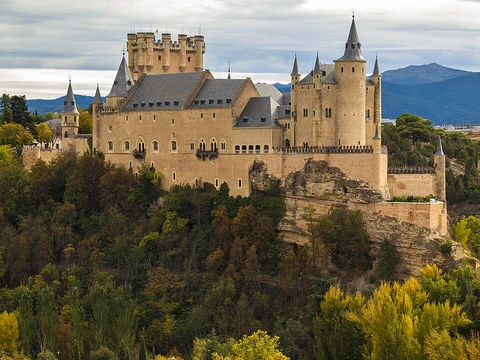
Prague Castle
Largest ancient castle complex and seat of Czech presidents.

Prague Castle (Czech: Pražský hrad) is a castle complex in Prague, Czech Republic, serving as the official residence and workplace of the president of the Czech Republic. Built in the 9th century, it has long served as the seat of power for kings of Bohemia, Holy Roman emperors, and presidents of Czechoslovakia. The term 'Prague Castle' or simply 'Hrad' is often used as metonymy for the president and his staff and advisors. The Bohemian Crown Jewels are kept within a hidden room inside it. According to the Guinness Book of Records, it is the largest ancient castle in the world, occupying an area of almost 70,000 square metres, at about 570 metres in length and an average of about 130 metres wide.
- location
- Prague, Czech Republic
- built
- 9th century (first walled building in 870)
- area
- Almost 70,000 square metres (750,000 square feet)
- length
- About 570 metres (1,870 feet)
- width
- Average about 130 metres (430 feet)
- visitors_2024
- 2.59 million
- record
- Largest ancient castle in the world per Guinness Book of Records
Verified Timeline
Lore & Background
The castle's history began in 870 when its first walled building, the Church of the Virgin Mary, was built. The Basilica of Saint George and the Basilica of St. Vitus were founded under the reign of Vratislaus I, Duke of Bohemia and his son Wenceslaus I in the first half of the 10th century. A Romanesque palace was erected here during the 12th century. King Ottokar II of Bohemia improved fortifications and rebuilt the royal palace for representation and housing. In the 14th century, under Charles IV, the royal palace was rebuilt in Gothic style and fortifications strengthened. Building began on a vast Gothic church that was completed almost six centuries later. During the Hussite Wars and following decades, the castle was not inhabited. In 1485, King Vladislaus II Jagiellon began to rebuild, adding the massive Vladislav Hall by Benedikt Rejt. A large fire in 1541 destroyed large parts. Under the Habsburgs, Renaissance buildings were added; Ferdinand I built the Belvedere for his wife Anne. Rudolph II used Prague Castle as his main residence, founding the northern wing with the Spanish Hall for his art collections. The Third Defenestration of Prague in 1618 took place at the castle, kick-starting the Bohemian Revolt. Many works from Rudolph II's collection were looted by Swedes in 1648. The last major rebuilding was carried out by Empress Maria Theresa in the second half of the 18th century. After the abdication of Ferdinand I in 1848, he made Prague Castle his home. In 1918, the castle became the seat of President Tomáš Masaryk. The New Royal Palace and gardens were renovated by Slovenian architect Jože Plečnik. St. Vitus Cathedral was finished on 28 September 1929. On 15 March 1939, Adolf Hitler spent a night in the castle after forcing President Emil Hácha to hand over the nation. During Nazi occupation, Reinhard Heydrich made the castle his headquarters. After the 1948 coup, the castle housed communist government offices. After Czechoslovakia split in 1993, the castle became the seat of the Head of State of the new Czech Republic. President Václav Havel commissioned Bořek Šípek for post-communist improvements.
Reader's Guide
Prague Castle is the most visited tourist attraction in the Czech Republic, attracting 2.59 million visitors in 2024. Its architecture blends styles from different periods, including Gothic St. Vitus Cathedral, Romanesque Basilica of St. George, a monastery, and several palaces, gardens, and defense towers. Most areas are open to tourists. The castle houses several museums: the National Gallery collection of Bohemian baroque and mannerist art, an exhibition dedicated to Czech history, a Toy Museum, and the picture gallery based on Rudolph II's collection. The Summer Shakespeare Festival regularly takes place in the courtyard of Burgrave Palace. The neighborhood around the castle is called Hradčany. Key structures include the Old Royal Palace, Queen Anne's Summer Palace (Belvedere), Lobkowicz Palace, and the New Royal Palace. Notable halls include the Vladislav Hall, Spanish Hall, and Rudolph's Gallery. Towers include the White Tower, Black Tower, Daliborka, and Mihulka. Other buildings include Golden Lane, the Old Supreme Burgrave's House, Ball Game Hall, Riding School, and the Picture Gallery. Gardens include the Royal Garden, Orangery, South Gardens, and Deer Moat. The Bohemian Crown Jewels are kept in a hidden room inside the castle.
Did You Know?
- The Bohemian Crown Jewels are kept within a hidden room inside Prague Castle.
- The Third Defenestration of Prague in 1618 took place at the castle, kick-starting the Bohemian Revolt.
- St. Vitus Cathedral was completed on 28 September 1929, nearly six centuries after construction began in the 14th century.
- Reinhard Heydrich, the Reich Protector, used Prague Castle as his headquarters during the Nazi occupation; a legend says a usurper who places the Bohemian crown on his head will die within a year, and Heydrich died less than a year after assuming power.
- Several 13th-century Venetian coins found at the castle were studied by the numismatist Zdenka Nemeškalová-Jiroudková.
Scale and Unbroken Sovereignty
Prague Castle holds a Guinness Book of Records designation as the world's largest ancient castle, stretching roughly 570 metres in length with an average width of about 130 metres and covering nearly 70,000 square metres. What makes this footprint remarkable is not merely its size but the unbroken thread of political authority it has housed since the 9th century. The first walled structure, the Church of the Virgin Mary, dates to 870, and from that modest beginning the complex grew into the seat of Bohemian kings, Holy Roman emperors, and later the presidents of Czechoslovakia and the Czech Republic. The term "Hrad" has become a metonymy so deep-rooted that referring to the castle is often shorthand for the sitting president, his staff, and his advisors. Even the Bohemian Crown Jewels, symbols of medieval sovereignty, remain locked in a hidden room within these walls, linking the present-day head of state to a lineage of power that spans more than a millennium.
A Palimpsest of Architectural Eras
Walking through Prague Castle is like reading a building history of Europe compressed into one site. The Romanesque Basilica of St. George, founded in the first half of the 10th century under Duke Vratislaus I and his son Wenceslaus I, still stands as the oldest surviving church structure within the complex. Beside it, the Gothic St. Vitus Cathedral began construction in the 14th century under Charles IV, replacing an earlier rotunda and basilica, yet was not completed until 28 September 1929—nearly six centuries of continuous work. The Old Royal Palace carries layers from the 12th-century Romanesque era through Charles IV's Gothic rebuild, the massive Vladislav Hall added in the late 15th century by master builder Benedikt Rejt, and Renaissance additions under the Habsburgs, including Queen Anne's Summer Palace commissioned by Ferdinand I. The northern wing, with its Spanish Hall, was created by Rudolph II to display his art collections. Even the defence towers on the north side and the diverse churches—the All Saints Church, the Holy Cross Chapel—testify to a site that has been rebuilt, expanded, and reimagined across every major architectural movement of the last thousand years.
Crises, Usurpers, and the Crown's Curse
Few places in Europe have witnessed so many violent ruptures of political order within a single complex. In 1618, the Third Defenestration of Prague—when officials were thrown from the castle windows—ignited the Bohemian Revolt and set the stage for the Thirty Years' War. Decades later, Swedish forces looted many of Rudolph II's treasured artworks during the 1648 Battle of Prague. The castle's darkest chapter arrived in 1939, when Emil Hácha, suffering a heart attack during negotiations, was coerced into surrendering Czech sovereignty, and Adolf Hitler spent a night within the walls surveying his new possession. The following years saw Reinhard Heydrich, the Reich Protector, establish his headquarters here. A persistent legend holds that anyone who places the Bohemian crown on their head is doomed to die within a year. Heydrich, according to rumor, did exactly that; he was ambushed in May 1942 by British-trained resistance fighters and died a week later of infected wounds. His firstborn son Klaus perished in a traffic accident the following year, seemingly fulfilling the curse.
Living Culture and the Modern Presidency
Today Prague Castle is simultaneously a working government office, a museum complex, and the Czech Republic's most-visited tourist destination, drawing 2.59 million visitors in 2024 alone. The site houses the National Gallery's collection of Bohemian baroque and mannerist art, a dedicated exhibition on Czech history, a Toy Museum, and the picture gallery rooted in Rudolph II's original collection. The courtyard of Burgrave Palace hosts the Summer Shakespeare Festival, bringing contemporary performance to a space that once echoed with royal court life. The surrounding neighbourhood, Hradčany, frames the complex in a residential context that softens its imperial grandeur. Architecturally, the castle's post-communist renewal mirrors an earlier pattern: just as Tomáš Masaryk commissioned Slovenian architect Jože Plečnik to renovate the New Royal Palace and gardens in the 1920s, President Václav Havel later entrusted Bořek Šípek with the facelift of the painting gallery. This continuity of presidential stewardship—each leader commissioning a new generation of architects to shape the castle's public face—reinforces the idea that Hrad is not a frozen monument but a living institution, perpetually being remade for the present while carrying the weight of its past.
Common Misconceptions (Editorial)
1. Some believe St. Vitus Cathedral was built in the medieval period, but it was not completed until 28 September 1929—nearly six centuries after construction began in the 14th century. 2. A common misconception is that the castle was always continuously inhabited by rulers; in fact, during the Hussite Wars and following decades, the castle was not inhabited.
Why It Matters (Editorial)
Prague Castle endures not only as the largest ancient castle in the world but as a living symbol of Czech sovereignty across more than a millennium of political upheaval. From housing kings and Holy Roman emperors to serving as the seat of democratic presidents and surviving Nazi occupation, its walls embody the resilience and continuity of the Czech state.
Frequently Asked Questions
Who is Prague Castle?
Prague Castle is a sprawling fortified complex perched on a hill above the Vltava River in Prague, Czech Republic. It currently serves as the official residence and working base of the Czech president.
What is Prague Castle's role?
It functions as both the presidential residence and the administrative headquarters for the head of state and their advisors. Over the centuries it has also housed Bohemian kings, Holy Roman emperors, and Czechoslovak presidents.
How big is Prague Castle?
The complex stretches roughly 570 metres in length and covers close to 70,000 square metres of ground. It drew over 2.5 million visitors in 2024, making it one of the most-visited castle sites in Europe.
When was Prague Castle first built?
The earliest walled structure on the site dates to around 870 AD, making it one of the oldest castle complexes still in continuous use. The grounds have been expanded and rebuilt across many centuries since that initial fortification.
Why is Prague Castle important?
It is the largest ancient castle complex in the world and has anchored political power in the region for well over a millennium. The Czech nickname "Hrad" is commonly used as shorthand for the president and the entire presidential staff.
More in Castles 1-22
Spotted an error? Know more?
This is a living reference — every entry is fact-audited, and reader corrections feed straight into our audit queue. Suggest an edit · See this site's audit record