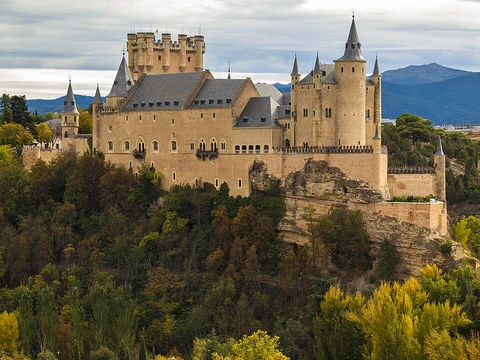
Hohenzollern Castle
Ancestral seat of the House of Hohenzollern, rebuilt as a family memorial.

Hohenzollern Castle (German: Burg Hohenzollern) is the ancestral seat of the formerly imperial House of Hohenzollern. The third of three hilltop castles built on the site, it is located atop Mount Hohenzollern, above and south of Hechingen, on the edge of the Swabian Jura in central Baden-Württemberg, Germany. The name derives from Söller (terrace), from the Latin solarium.
- Location
- Mount Hohenzollern, above Hechingen, Baden-Württemberg, Germany
- Elevation
- 855 metres (2,805 ft) above sea level
- First castle built
- Early 11th century
- Current castle built
- 1846–1867
- Architect
- Friedrich August Stüler
- Style
- English Gothic Revival and Loire Valley châteaux
- Annual visitors
- Over 350,000
Verified Timeline
Lore & Background
The first castle on the mountain was constructed in the early 11th century. Over the years, the House of Hohenzollern split several times, but the castle remained in the Swabian branch, the dynastic seniors of the Franconian-Brandenburgian cadet branch that later acquired its own imperial throne. This castle was completely destroyed in 1423 after a ten-month siege by the free imperial cities of Swabia. The second castle, a larger and sturdier structure, was constructed from 1454 to 1461, and served as a refuge for the Catholic Swabian Hohenzollerns, including during the Thirty Years' War. By the end of the 18th century, it was thought to have lost its strategic importance and gradually fell into disrepair, leading to the demolition of several dilapidated buildings. The third, and current, castle was built between 1846 and 1867 as a family memorial by Hohenzollern scion King Frederick William IV of Prussia. Architect Friedrich August Stüler based his design on English Gothic Revival architecture and the châteaux of the Loire Valley. No member of the Hohenzollern family was in permanent or regular residence when it was completed, and none of the three German Emperors of the late 19th and early 20th century German Empire ever occupied the castle. In 1945, it briefly became the home of the former Crown Prince Wilhelm of Germany, son of the last Hohenzollern monarch, Kaiser Wilhelm II.
Reader's Guide
Hohenzollern Castle is significant as the ancestral seat of the House of Hohenzollern, a dynasty that produced Prussian kings and German emperors. The current castle, built as a family memorial, reflects 19th-century Romanticism and an idealized vision of a medieval knight's castle. It houses historical artifacts of Prussian history, including the Crown of Wilhelm II, personal effects of King Frederick the Great, and paintings of the Hohenzollern dynasty. The castle is privately owned by the House of Hohenzollern, with two-thirds belonging to the Brandenburg-Prussian branch and the balance to the Swabian branch. With over 350,000 visitors per year, it is one of the most visited castles in Germany. The castle was heavily damaged by an earthquake in 1978 and was under repair until the mid-1990s. It has also been used as a filming location for movies and television.
Did You Know?
- The castle's name derives from Söller (terrace), from the Latin solarium.
- The first castle was completely destroyed in 1423 after a ten-month siege by the free imperial cities of Swabia.
- The current castle was built between 1846 and 1867 as a family memorial by King Frederick William IV of Prussia.
- In 1945, the castle briefly became the home of the former Crown Prince Wilhelm of Germany, son of Kaiser Wilhelm II.
- The castle was heavily damaged by a Ms 5.7 earthquake on 3 September 1978, causing some turrets to collapse.
A Hilltop Through Three Ages
The site atop Mount Hohenzollern has hosted three successive fortifications, each reflecting the ambitions of its era. The earliest, raised around 1040 by the Counts of Zollern, was a modest medieval stronghold that earned the epithet "crown of all castles in Swabia" in contemporary accounts. That first structure met a violent end in 1423, obliterated after a grueling ten-month siege waged by the Swabian League of Cities. A sturdier second castle followed between 1454 and 1461, serving as a refuge for the Catholic Swabian Hohenzollerns through the Thirty Years' War and beyond. Yet by the late 1700s, its strategic value had faded; after the last Austrian owner departed in 1798, the complex slowly crumbled, and by the early 1800s only the Chapel of St. Michael remained in any usable condition. The mountain itself—an isolated promontory of the Swabian Jura rising 855 metres above sea level, 234 metres above the town of Hechingen—had endured, waiting for a third and far grander chapter.
A Dream Made Stone
In 1819, a young Crown Prince Frederick William IV climbed Mount Hohenzollern while traveling through southern Germany, drawn by a curiosity about his family's origins. The sunset he witnessed from a castle bastion lodged in his memory for decades. By 1844, as King, he articulated a long-held wish to see the hilltop made habitable once again. He commissioned Friedrich August Stüler, a former student of Karl Friedrich Schinkel, to design a new structure. Stüler's plan, begun in 1846, wove together English Gothic Revival forms with the sweeping elegance of Loire Valley châteaux. Construction actually commenced in 1850 and was financed entirely by the Brandenburg-Prussian and Hohenzollern-Sigmaringen branches of the family. The ornate entryway was the work of Moritz Karl Ernst von Prittwitz, Prussia's foremost fortifications engineer, while sculptor Gustav Willgohs crafted the figures adorning the building. The project was completed on 3 October 1867 under King William I. Like Neuschwanstein, the castle embodied German Romanticism's idealized medieval vision, though it eschewed that Bavarian sibling's more fantastical excesses.
Dynastic Seat and Political Pawn
Although the House of Hohenzollern first appears in written records in 1061, the castle itself is named "Castro Zolre" in a 1267 document, a name tracing back to the Latin solarium, meaning terrace. The Swabian branch retained the hilltop as its ancestral seat even as the family fractured over the centuries; the Franconian-Brandenburgian cadet line eventually seized the imperial throne, yet the Swabian holders remained the dynastic seniors. The castle's strategic perch made it a recurring target. Württemberger troops seized the second structure in 1634 during the Thirty Years' War, and Habsburg hands controlled it for roughly a century afterward. French soldiers occupied it in the winter of 1744-45 during the War of the Austrian Succession. After returning to Habsburg stewardship, the fortress saw little active use. The castle's political weight shifted again in 1945, when Crown Prince Wilhelm, son of the last Kaiser, briefly sheltered there ahead of advancing Soviet forces. His and his wife Cecilie's caskets now rest within the castle, as their Brandenburg estates had fallen under Soviet occupation at the time of their deaths.
Treasures of a Fallen Dynasty
The castle's interior holds a curated collection of Prussian and Hohenzollern memorabilia that speaks to a family whose political power has long since dissolved. Among the most significant pieces is the Crown of Wilhelm II, the last German Emperor, alongside personal effects and a uniform belonging to King Frederick the Great. Paintings tracing the dynastic lineage line the walls. For decades, the museum also displayed a letter from American President George Washington expressing gratitude to Baron von Steuben, a Hohenzollern relative, for his service in the Revolutionary War. Beginning in 1952, Prince Louis Ferdinand of Prussia systematically gathered valuable artworks and historical artifacts from the scattered Hohenzollern family collections and the former Hohenzollern Museum at Schloss Monbijou, rebuilding the castle's role as a repository of dynastic memory. From 1952 until 1991, the caskets of Frederick William I and his son Frederick were also housed within the castle. No Hohenzollern emperor ever occupied the building as a residence; it functioned primarily as a showpiece and memorial, a monument to a lineage that once commanded an empire.
Common Misconceptions (Editorial)
Some may assume that Hohenzollern Castle was continuously occupied by the Hohenzollern family after its construction, but the facts show that no member of the family was in permanent or regular residence when the current castle was completed, and none of the three German Emperors ever occupied it. Others might think the castle was built primarily as a defensive fortress, but it was actually built between 1846 and 1867 as a family memorial. Additionally, while the castle is often associated with the later German emperors, it remained under the Swabian branch, not the Franconian-Brandenburgian branch that produced the emperors.
Why It Matters (Editorial)
Hohenzollern Castle endures as a symbol of the complex legacy of German aristocracy, bridging medieval roots and 19th-century romantic nationalism without ever serving as a lived-in seat of imperial power. Its popularity today—drawing over 350,000 annual visitors—reflects a lasting fascination with royal heritage, even when that heritage is more memorial than lived reality.
Frequently Asked Questions
What is Hohenzollern Castle?
It is the ancestral seat of the House of Hohenzollern, a formerly imperial German dynasty. The building you see today is the third castle ever raised on that hilltop location.
What role does Hohenzollern Castle play?
It functions as the family seat and a dedicated memorial to the Hohenzollern lineage. The present structure was deliberately designed and erected as a commemorative monument celebrating the dynasty's history.
When was the current Hohenzollern Castle built?
Construction ran from 1846 to 1867 under architect Friedrich August Stüler. The design blends English Gothic Revival detailing with stylistic elements drawn from French Loire Valley châteaux.
Why is Hohenzollern Castle important?
It is the ancestral home of the House of Hohenzollern, the dynasty that produced Prussian kings and German emperors. Its commanding position on an 855-metre peak makes it one of the most recognizable castle silhouettes in all of Germany.
Where is Hohenzollern Castle located?
It crowns Mount Hohenzollern, sitting just above and south of the town of Hechingen in central Baden-Württemberg. The site rests on the edge of the Swabian Jura at roughly 855 metres (2,805 ft) above sea level.
More in Castles 1-22
Spotted an error? Know more?
This is a living reference — every entry is fact-audited, and reader corrections feed straight into our audit queue. Suggest an edit · See this site's audit record