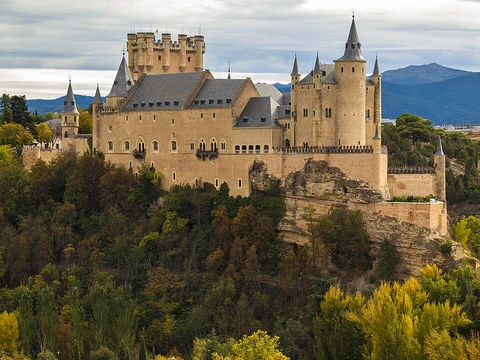
Predjama Castle
Renaissance castle built within a cave mouth in south-central Slovenia.

Predjama Castle is a Renaissance castle built within a cave mouth in south-central Slovenia, in the historical region of Inner Carniola. It is located in the village of Predjama, approximately 11 kilometres from the town of Postojna and 9 kilometres from Postojna Cave. The castle was first mentioned in 1274 with the German name Luegg, when the Patriarch of Aquileia built the castle in Gothic style under a natural rocky arch high in the stone wall to make access to it difficult.
- Location
- Predjama, Inner Carniola, Slovenia
- First mentioned
- 1274
- Original name
- Luegg
- Builder
- Patriarch of Aquileia
- Style
- Gothic (original), Renaissance (current)
- Notable resident
- Erasmus of Lueg (15th century)
- Current use
- Museum
Lore & Background
The castle was first mentioned in 1274 with the German name Luegg, when the Patriarch of Aquileia built the castle in Gothic style. It was later acquired and expanded by the Luegg noble family, also known as the Knights of Adelsberg. The castle became known as the seat of the knight Erasmus of Lueg, lord of the castle in the 15th century and a renowned robber baron. He was the son of the imperial governor of Trieste, Nikolaj Lueger. According to legend, Erasmus came into conflict with the Habsburgs when he killed the commander of the imperial army, Marshal Pappenheim, who had offended the honour of Erasmus's deceased friend and famous condottiere Andrej Baumkircher of Vipava. Fleeing the vengeance of the Holy Roman Emperor Frederick III, Erasmus reached the family fortress of Predjama. From there, he allied himself with King Matthias Corvinus and began to attack Habsburg estates and towns in Carniola. The emperor commissioned the governor of Trieste, Andrej Ravbar, with the capture or killing of Erasmus. Erasmus was killed after a long siege. According to a popular but unfounded legend, Erasmus was betrayed by one of his men and was killed by a shot from a cannon in his lavatory. A vertical natural shaft, which Erasmus ordered to be enlarged, leads out of the original castle and leads to the exit located at the top of the cliff, 25 meters away from the cliff's edge. During the siege, this shaft allowed Erasmus to secretly supply the castle with food and to continue with his robberies.
Reader's Guide
After the siege and destruction of the original castle, its ruins were acquired by the Oberburg family. In 1511, the second castle, built by the Purgstall family in the first decade of the 16th century, was destroyed in an earthquake. In 1567, Archduke Charles of Austria leased the castle to Baron Philipp von Cobenzl, who paid it off after 20 years. In 1570, the current castle was built in the Renaissance style, pressed next to a vertical cliff under the original medieval fortification. The castle has remained in this form, virtually unchanged, to the present day. In the 18th century, it became one of the favourite summer residences of the Cobenzl family, together with nearby Haasberg Castle. Both the Austrian statesman and art collector Philipp von Cobenzl and the diplomat Count Ludwig von Cobenzl spent time in the castle. In 1810, the castle was inherited by Count Michael Coronini von Cronberg, and in 1846 it was sold to the Windischgrätz family, who remained its owners until the end of World War II, when it was confiscated and nationalized by the Yugoslav Communist authorities and turned into a museum.
Did You Know?
- The castle was first mentioned in 1274 with the German name Luegg.
- A vertical natural shaft, enlarged by Erasmus, leads from the original castle to an exit 25 meters from the cliff's edge.
- According to a popular but unfounded legend, Erasmus was killed by a cannon shot in his lavatory.
- The current Renaissance castle was built in 1570 and has remained virtually unchanged to the present day.
- The castle was nationalized by Yugoslav Communist authorities after World War II and turned into a museum.
Common Misconceptions (Editorial)
1. A common misconception is that Erasmus of Predjama was betrayed by a servant and killed by a cannon shot while using the lavatory. According to the facts on record, this story is a popular but unfounded legend, not a verified historical event. 2. Some people believe the castle is purely medieval in origin. In fact, while it was first built in Gothic style in 1274, the current structure is a Renaissance castle built in 1570 and has remained virtually unchanged since then.
Why It Matters (Editorial)
Predjama Castle endures as a powerful symbol of resistance and ingenuity, its dramatic cliffside location and secret supply shaft embodying the daring legend of Erasmus of Lueg. The castle’s seamless blend of natural cave and human architecture, combined with its survival through centuries of political upheaval, makes it a uniquely compelling testament to Slovenia’s layered history and a lasting draw for visitors worldwide.
Frequently Asked Questions
What is Predjama Castle?
Predjama Castle is a medieval fortress built directly into the mouth of a limestone cave in south-central Slovenia. It perches dramatically on a cliff face in the village of Predjama, within the historical region of Inner Carniola.
Where exactly is Predjama Castle located?
The castle stands in the small village of Predjama, roughly 11 km from the town of Postojna and about 9 km from the Postojna Cave system. It sits in the Inner Carniola area of Slovenia.
Who is Erasmus of Lueg and why is he tied to Predjama Castle?
Erasmus of Lueg was a 15th-century nobleman who resided in the castle and earned a legendary reputation as a 'robber baron' who preyed on travelers passing below. His story has made the fortress one of Slovenia's most storied historical sites.
What architectural style does Predjama Castle feature?
The structure was originally constructed in a Gothic style but was later rebuilt in the Renaissance period, which is the form visitors encounter today. Its first recorded mention dates to 1274, making it nearly eight centuries old.
Who originally built Predjama Castle and what was its earlier name?
The castle was commissioned by the Patriarch of Aquileia and was originally called 'Luegg.' Over the centuries it was renovated and expanded, evolving from its Gothic roots into the Renaissance fortress seen today.
More in Castles 1-22
Spotted an error? Know more?
This is a living reference — every entry is fact-audited, and reader corrections feed straight into our audit queue. Suggest an edit · See this site's audit record