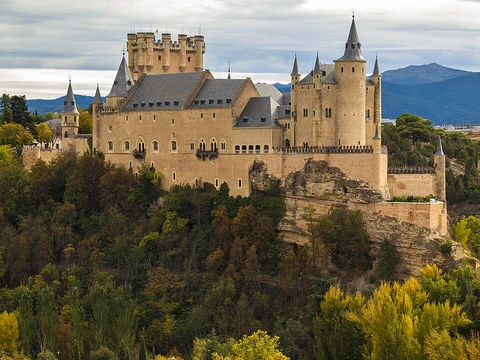
Osaka Castle
Japanese castle key to sixteenth-century unification.

Osaka Castle (大坂城 or 大阪城, Ōsaka-jō) is a Japanese castle in Chūō-ku, Osaka, Japan. The castle is one of Japan's most famous landmarks and played a major role in the unification of Japan during the sixteenth century of the Azuchi–Momoyama period. Its construction was initiated in 1583 by Toyotomi Hideyoshi on the site of the Ikkō-ikki temple of Ishiyama Hongan-ji, modeled after Azuchi Castle, and it later became a focal point of the Siege of Osaka in the early 1600s.
- Location
- Chūō-ku, Osaka, Japan
- Construction started
- 1583
- Completed
- 1597
- Main keep stories
- Five outside, eight inside
- Castle grounds area
- Approximately 61,000 square metres (15 acres)
- Notable period
- Azuchi–Momoyama period
- Current structure
- Ferroconcrete tenshu built in 1931
Verified Timeline
Lore & Background
In 1583 Toyotomi Hideyoshi commenced construction on the site of the Ikkō-ikki temple of Ishiyama Hongan-ji. The basic plan was modeled after Azuchi Castle, the headquarters of Oda Nobunaga. Hideyoshi wanted to build a castle that mirrored Nobunaga's but surpassed it in every way: the plan featured a five-story main tower with three extra stories underground and gold leaf on the sides to impress visitors. In 1585, the Inner donjon was completed. Hideyoshi continued to expand the castle, making it increasingly formidable to attackers. Construction was completed in 1597, and Hideyoshi died the following year. Osaka Castle passed to his son, Toyotomi Hideyori. In 1614, Tokugawa Ieyasu besieged the Toyotomi clan forces in Osaka castle during the winter, starting the Siege of Osaka. Although the Toyotomi forces were outnumbered approximately two to one, they managed to fight off Tokugawa's 200,000-man army and protect the castle's outer walls. Ieyasu had the castle's outer moat filled, thereby negating one of its main outer defenses. During the summer of 1615, Hideyori began to restore the outer moat. Ieyasu, in outrage, sent his armies to Osaka Castle again, and routed the Toyotomi men inside the outer walls on June 4. Later, Osaka Castle fell to the Tokugawa shogunate and the Toyotomi clan perished, as Toyotomi Hideyori and Yodo-dono committed seppuku and the castle buildings burned to the ground. After the Toyotomi clan no longer existed, the Tokugawa shogunate expressed its desire to relocate its capital to Osaka. However, this plan to relocate the shogunate to Osaka was halted after Ieyasu died in 1616. For a while, the shogunate's plan to move to Osaka was abandoned. Still, it was reinstated by Tokugawa Hidetada, who strongly desired to establish a unified imperial and military government. In 1619, Matsudaira Tadaaki, who was appointed as the lord of Osaka Castle before, was transferred to the Kōriyama Domain in Yamato Province, and the shogunate assumed direct control of Osaka. Then, the project of reconstructing Osaka castle as a new base of the shogunate was entrusted to Tōdō Takatora and Kobori Enshu. In 1620, the old structures of Osaka Castle were dismantled so that the foundation for the new castle could be built. He assigned the task of constructing new walls to individual samurai clans. The walls built in the 1620s still stand today and are made out of interlocked granite boulders without mortar. Many of the stones were brought from rock quarries near the Seto Inland Sea and bear inscribed crests of the various families who contributed them. The shogunate also built a new elevated central tower, five stories on the outside and eight stories on the inside. Construction of the tenshu started in 1628 and was completed two years later, about the same time as the rest of the reconstruction, and followed the general layout of the original Toyotomi structure. However, it was built in a different part of the Honmaru (main bailey), as the base of the Toyotomi keep had actually been buried by the new Tokugawa version of the castle. After a long period of construction, the new Osaka Castle was completed in 1628.
Reader's Guide
Osaka Castle's significance lies in its central role in the unification of Japan during the Azuchi–Momoyama period and its subsequent history under the Tokugawa shogunate. The castle was the site of the pivotal Siege of Osaka (1614–1615), which ended the Toyotomi clan and solidified Tokugawa Ieyasu's control. Its reconstruction in the 1620s by the shogunate, using interlocked granite boulders without mortar, produced walls that still stand today. The castle also served as a military arsenal under the Meiji government, manufacturing weapons for Japan's Western-style military, and was heavily damaged by American bombing in World War II. In 1931, a ferroconcrete tenshu was built, and a 1995–1997 restoration aimed to restore the main keep to its Edo-era splendor, resulting in a concrete reproduction with elevators that now functions as a museum. The castle grounds contain thirteen structures designated as Important Cultural Assets by the Japanese government, including gates, turrets, wells, and storehouses. The castle is open to the public and easily accessible from Osakajōkōen Station on the JR West Osaka Loop Line.
Did You Know?
- In 1660, lightning ignited the gunpowder warehouse, and the resulting explosion set the castle on fire.
- In 1665, lightning struck and burnt down the tenshu.
- On August 14, 1945, American bombing destroyed 90% of the Osaka Army Arsenal and killed 382 workers.
- The walls built in the 1620s still stand today and are made out of interlocked granite boulders without mortar.
- In 1740, hatamoto guard Kajisuke Nakama stole 4,000 ryō of gold from the castle, was arrested, and was later crucified.
Common Misconceptions (Editorial)
Some people believe that the main towers (tenshu) of Osaka Castle seen today are the original structures from the 1590s. In fact, the original castle burned down in 1615, the Tokugawa-era tenshu was struck by lightning and destroyed in 1665, and the current ferroconcrete tenshu was built in 1931. Another common misconception is that the stone walls date from Toyotomi Hideyoshi’s original castle, when they were actually built in the 1620s from interlocked granite boulders without mortar, commissioned by the Tokugawa shogunate.
Why It Matters (Editorial)
Osaka Castle endures not only as a physical landmark but as a symbol of Japan’s unification and the dramatic rise and fall of the Toyotomi clan. Its history encapsulates the ambition of Hideyoshi, the ruthless consolidation of power by Tokugawa Ieyasu, and the resilience of a structure that has been rebuilt multiple times after war and disaster. The castle remains a powerful reminder of how political ambition, warfare, and architecture intertwine to shape a nation’s identity.
Frequently Asked Questions
What is Osaka Castle?
Osaka Castle is a historic Japanese fortress in Chūō-ku, Osaka, widely regarded as one of the nation's most iconic landmarks. Toyotomi Hideyoshi commissioned its construction in 1583, raising it on the former grounds of the Ishiyama Hongan-ji temple.
What role did Osaka Castle play in Japanese history?
The castle functioned as a military and political seat during the Azuchi–Momoyama period, helping to consolidate the unification of Japan in the late 1500s. It was deliberately modeled on Azuchi Castle to project Hideyoshi's authority across the country.
How does Osaka Castle's story end?
The fortress became the decisive battleground in the Siege of Osaka in the early 1600s, where Tokugawa forces defeated the last loyalists of the Toyotomi clan. That conflict effectively ended the Toyotomi line and locked in Tokugawa dominance over the newly unified realm.
Why is Osaka Castle considered so important?
It stands as a defining monument of Japan's transition from warring states to centralized rule, embodying the political ambitions of the unification era. The grounds span roughly 61,000 square metres, and the main keep is a striking five-storey exterior structure concealing eight internal levels.
When was Osaka Castle finished and what makes its keep distinctive?
Construction wrapped up in 1597, roughly fourteen years after the 1583 groundbreaking. The keep's design hides three extra floors inside the five visible ones, a deliberate trick to make the tower appear taller and more imposing to approaching enemies.
More in Castles 1-22
Spotted an error? Know more?
This is a living reference — every entry is fact-audited, and reader corrections feed straight into our audit queue. Suggest an edit · See this site's audit record